



Your drying line determines everything. While your extruder shapes perfect penne and your cutter slices uniform spaghetti, the drying tunnel decides whether your facility ships product today or waits until tomorrow. Conventional hot-air systems stretch across 60 to 70 meters of factory floor, according to Italian Food Tech documentation on pasta tunnel dryer design. They consume 8 to 12 hours per batch. They drain energy budgets and force separate pasteurization steps that add cost and complexity you do not need.
You already know this bottleneck costs you money. What you may not know is that microwave dry pasta technology collapses this constraint entirely. Drying cycles drop from hours to under 90 minutes. Floor space requirements shrink by up to 90%. The process delivers simultaneous pasteurization in a single pass. A peer-reviewed study in the Journal of Food Engineering demonstrated that microwave-assisted drying reduced short-cut pasta dehydration time by more than 10x compared to conventional methods, without compromising product appearance.
In this guide, you will be walked through a complete look into the mathematics behind the process of microwave-assisted pasta drying environments, the various types best suited, comparative performance characteristics when pitted against conventional methodologies, as well as determination of the best continuous pasta drying equipment for your production line. By the end, optimal processes for the most desirable results will have been considered, the requirements to look for regarding individual products governed, and calculations to return real values in the form of enhanced throughput, energy savings, and eliminated sterilization heating costs.
Ready to cut your drying time in half? Contact our engineering team today to discuss a custom microwave pasta drying assessment for your facility.
What Is Microwave Dry Pasta Technology?
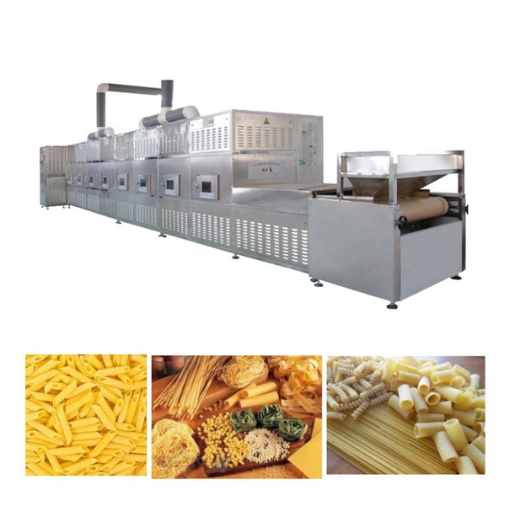
How Industrial Microwave Drying Works for Pasta
The conventional dryers are based on hot air being dispersed against the exposed surface of pasta. The moisture diffuses within the pasta slowly through the porous material to the surface where it will evaporate out. Drying profiles develop inside about on-going drying with a tendency toward case hardening and slow speed.
The industrial microwave drying uses a completely different but fundamentally same method of basic process operation. It literally eliminates multiple inefficiencies probable in the conventional method. Microwaves are set directly into the pasta while water molecules, heated by this microwave wavelength, will vibrate their way right inside through the pasta anybody could suggest. If microwaves sprinkle over and between the food in such a way as to vibrate themselves, water molecules will collide against each other, creating some heat. Volatile removal starts, without any significant heat extent outside, escaping through swelling and easy transitions in ionic strands. Finer gradation and quicker forced ventilative drying are the possible benefits.
For pasta manufacturers, this means dried products with consistent moisture content, reduced surface cracking, and superior rehydration properties. The technology applies equally to short-cut shapes, long-cut strands, and instant noodle formulations. An industrial microwave dryer configured for pasta processing delivers these results at commercial scale.
The Three-Stage Hybrid Process
Pure microwave drying for pasta is rarely cost-effective. A real industrial solution would combine hot air and microwave technology in a staged hybrid configuration.
Stage 1: Hot-air Pre-drying. Fresh extruded pasta enters with roughly 30% moisture content: standard industrial pasta production parameter. Hot air dries from its surface moisture with huge efficiency until the product reaches down to perhaps 18% moisture. This process is most suitable for the removal of free water which is limited to the surface.
Stage 2: Microwave-Assisted Drying. Neutral air partially dries the pasta and sends it to a microwave zone where moisture is targeted by volumetric heating. All prior technologies moved the moisture away; thereafter, 18% moist pasta had experienced a rise to 12% to 13.5% moisture content in 12 minutes with an engineering approach involving a temperature of 82°C and a 915 MHz microwave generator. The evaporated moisture was then removed by the combined hot-air circulation.
Step 3: Equalizing. With no source of heat, the dried pasta moves into a zone where it cools down and equalizes the moisture content. In this phase, moisture starts to move how Pachyodonto described it all along…slowly and gently. The `equalization´ does not destroy product structure; with no pressure and no-heat stress, it ensures that the pasta takes on the final moisture target of 12% to 12.5% needed to inseminate dry pasta ready for shelf life.
Total Processing Time: Instead of a range of 8 to 12 hours as one would encounter in purely conventional drying, the estimated processing time amounts to approximately 1.5 hours.
Equipment Types for Pasta Production
Three main examples of equipment configurations for pasta manufacturers include:
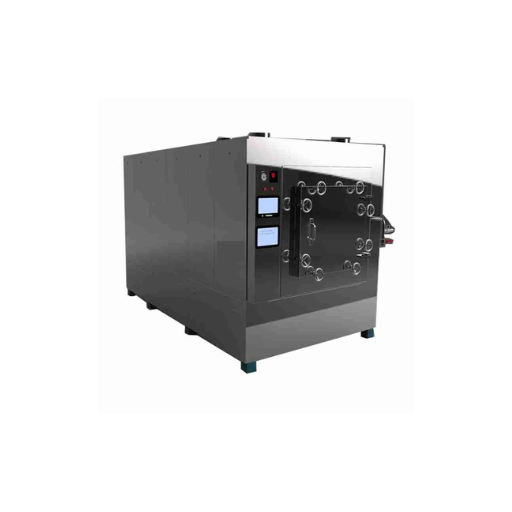
Batch Cabinet Dryers. In a smaller scale of usage, they typically work on 50-500 kg per batch. In this process, the microwave generator of 24-30 kW will load the product into trays within a stainless steel chamber. Batch systems will find a niche in R&D institutions, specialty makers of pasta products or the development laboratory that are concerned with immediate recipe-testing rather than continuous flow.
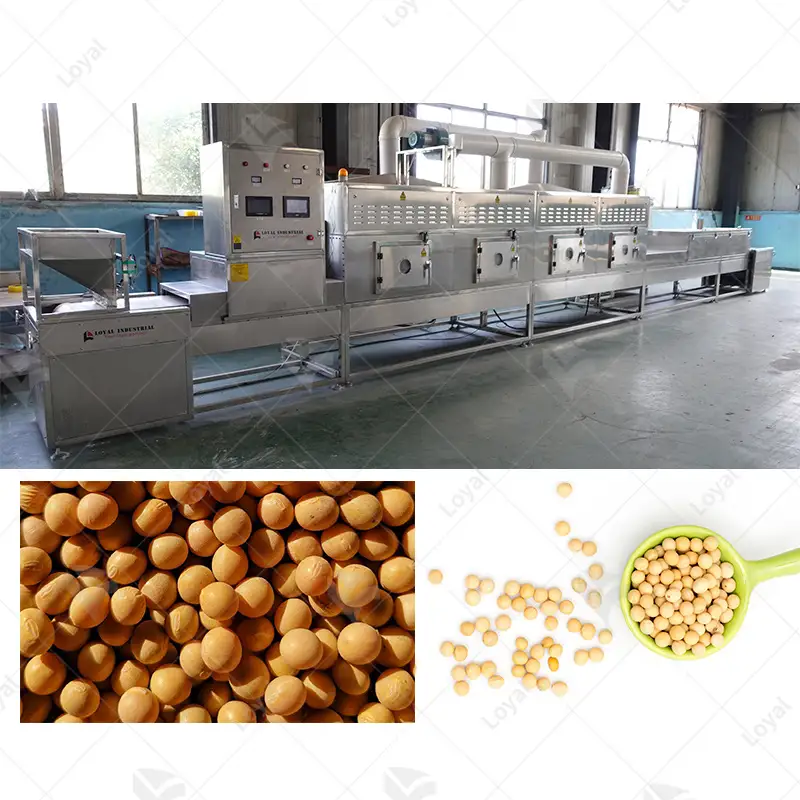
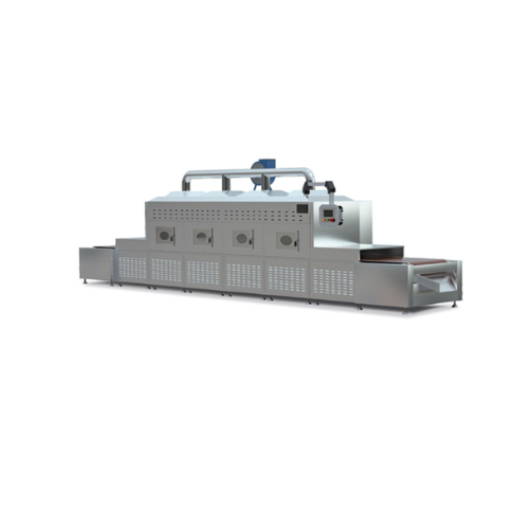
Tunnel Continuous Dryers. Belt-through systems process 500 kg/h to 3,000 kg/h or more. Pasta enters on a food-grade conveyor and passes sequentially through pre-dry, microwave, and equalizing zones. A microwave tunnel dryer integrates directly with extrusion and cutting lines for fully automated pasta production line operation, enabling reliable continuous processing at industrial scale. Most commercial pasta manufacturers specify these continuous pasta drying equipment configurations.
Microwave-Vacuum Systems, we know that it runs at low pressure, generally 40 millibars(reduced pressure implies reduced boiling point of water as in some cases this pressure may necessitate water to boil at 30°C to 50°C). To create an instant noodle or fast-cooking pasta resembles a porous, puffed microstructural engineering material. From a practical point of view, rehydrating 2 minutes works for a product versus 5 minutes or more compared to conventionally dried products.
Key System Components
The essential components for bakery application such as pasta-microwave dryers are as follows:
- A magnetron array, which generates energy (microwave) (very high frequency) at 915 MHz or 2450 MHz. In heavy pasta shapes, a system that includes 915 MHz is used by industrial pasta systems for deep depth of penetration.
- Conveyor Belt Dryer System: For product transport throughout the drying zones, comprising food-grade stainless steel mesh or PTFE-coated fiberglass belts. The variable frequency drive assists in adjusting the belt’s speed for time control.
- Drying Chamber: A sealed stainless steel-cavity with a microwave-suppression mechanism at entry and exit points, causing no leakage.
- Temperature Sensors: Infrared and thermocouples monitor in real time the surface and internal temperatures of the product.
- PLC Control System: A touch screen program that is operated by means of needle command, adjusting power input, belt speed, temperature for the zones, and recipe storage. There are also setups for Penne, spaghettil, fusilli, and etc. meta-product lines.
When Marco Verratti, Director of Operations at a mid-sized pasta production plant in Northern Italy, surveyed machinery replacement in early 2024, the conventional tunnel consumed all of the 68 m² floor as well as 10 hours per batch. Output was naturally capped at 800 kg/day. The penne-drying occupancy after the installation of a 50 kW continuous microwave-hybrid tunnel plummeted to 35 minutes and rose to 3,500 kg/day. Hence energy was used 30% less. Most surprising is the reduction in floor space: The new system used 85% less space than the original tunnel system and the freed 4,200 m² allowed a new packaging line that had not previously had a home.
Why Microwave Drying Outperforms Traditional Pasta Drying Methods
Microwave vs. Hot-Air Tunnel Drying
Conventional hot-air tunnel dryers are considered the normal when evaluating microwave dry pasta production systems. They are not fancy, with simpler mechanics and known much wider and are, in the end, seen to be outcast. Speed, energy efficiency, and quality are some areas where microwave-hybrid systems can completely destroy the efficiencies of conventional systems.
Time for the system to dry: Hot dryers require 6-8 hours for a short cut pasta while needing more than 8-12 hours for a long-cut pasta. Microwave-hybrid dry pasta production systems can finish semidrying within 30-90 minutes, depending on the thickness of the product and the initial moisture value.
Energy Efficiency: With a humble 9%-12% thermal efficiency, a conventional basic hot-air drying system is easy to analyze. Most of the energy input goes into heat loss to the environment (drying room, ductwork), or in the case of microwave systems (no ducts), many components like waveguide seal leakage, direct microwave emission, et cetera. Microwave-hybrid dry pasta systems have mean thermal efficiencies of 46%-58%. This implies a 26% reduction in power usage. This fact, as opposed to other cost-saving measures, makes a significant saving per operational cost.
Tunnel floorspace for long, conventional pasta goes to as low as 60 to 70 meters. A microwave-hybrid system capable of delivering identical output fits in 6 to 10 meters. Where available or expensive even as a matter of mere expansion-floor space difference, this justifies the investment by itself.
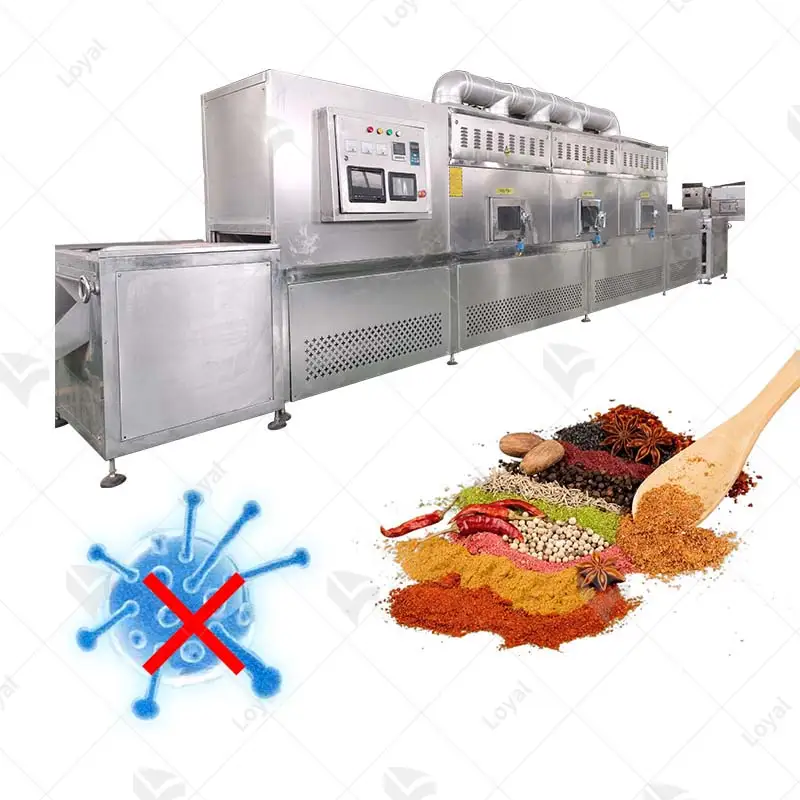
Food Safety: Products remain in conventional dryers for hours at temperatures between 40°C and 60°C during certain phases. These conditions promote bacterial growth. Microwave drying reaches higher internal temperatures rapidly, delivering a natural pasteurization effect that reduces microbial counts by approximately 90%. This eliminates or reduces the need for separate sterilization equipment and processes. For facilities requiring validated pathogen control, combining microwave drying with dedicated microwave sterilization equipment provides comprehensive food safety assurance.
Microwave vs. Infrared Drying
Heat radiation from ceramic or quartz emitters is absorbed by infrared dryers, causing surface heating (heat migration inwards). Here again arises the fundamental issue of slow migration of moisture from inside to outside, as it does with hot-air drying.
Tossing a different wrench now, microwave power reaches all the way inside the center of the product. The 915 MHz equipment commonly employed by industries can penetrate 10-20 centimeters into the dough, at which it would otherwise be moist. In contrast, infrared energy is plausible only in its vicinity, down to a matter of millimeters. Microwaves offer more even drying in thick pasta shapes or clumps of dense noodles.
Infrared wouldn’t produce efficient drying until the surface has been burnt while still imperfect through the middle. Microwave’s self-heating abilities lend itself to a more thorough drying action.
Microwave vs. Freeze Drying
With respect to some product types, freeze drying secures a product of unmatched quality. This procedure freezes with the sublimation of ice directly to vapor under vacuum. Their overall efficacy is extraordinary, but break-even or operating costs are equally astounding.
The freeze dryers use from 3 to 5 times the energy for per kg of water removed as microwaves do. One of the worst offenders, normally, had cycle times of 20 to 40 hr. Once industrial freeze-drying lines are started for the investment of $500 or less, they spend well.
Freeze-drying does not make economic sense for the production of stable pressure-pak dry pasta products on a commercial scale. For 20% of the cost and cycle time of freeze drying, microwave hybrid drying provides all the quality features of freeze drying.
The Case-Hardening Problem
Case hardening is when the quality of the pasta is impaired because the surface moisture dries faster than that it could migrate towards the outside. While the surface layer dries out hard and impermeable, interior moisture is locked inside. The dried pasta produced in such conditions is very easy to break, not very good in texture, and badly rehydrates.
The basic risk of hot-air drying is thus that the interior layers are very moist when surface heating turns on immediate evaporation. Microwave dry pasta processing, on the other hand, generates internal heat and pressure, thanks to which moisture is pushed out gently all over. Vertical-temperature gradients herein play a beneficial role instead of unfavorable. Meaning: Case hardening significantly diminishes, with products getting dry almost uniformly from the core to the surface.
Best Pasta Types for Microwave Dry Pasta Production
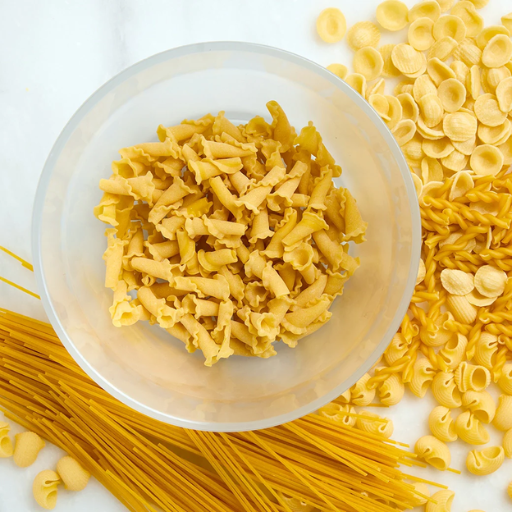
Short-Cut Pasta
Pasta types that are shaped like penne, macaroni, fusilli, rotini, and such rotini respond to microwave-hybrid drying very well. The compact geometry of such types yields a uniform microwave penetration. Besides because of the short length appetites, breakage risks for them are reduced during the conveying system.
One continuous industrial pasta dryer of 50 kW processes short-cut pasta between 1,200 and 2,000 kg per hour, depending on their shape density. The drying parameters normally maintain 75°C to 85°C in the microwave zone with a 8- to 15-minute dwell time. In the rotini-shaped pasta, microwave drying works towards benefit on the structure because each coil has a twisted surface to allow itself to open for hot-air predrying, while the center receives even microwave energy.
Long-Cut Pasta
Spaghetti, fettuccini, linguine, and tagliatelle pose problems in microwave drying owing to their size and lent structure that this is to say there would be a likelihood of breaking apart if the conveyor vibrates and thereby reflects the improper design of transfer-point.
For a long pasta configuration, a belt dryer is an advantage on a wide conveyor without many transients. The drying temperatures are aimed to be a little lower, around 70-80 degrees to prevent starch degradation and thus brittleness. All such products are on-line in a range of 12-18 minutes.
The microwave dried pasta system enjoys 10 times improvement in speed, whether shorter shape or long-cut. Eastern European production houses for fettuccine have used an 80 kW continuous tunnel dryer, with inbuilt warm air predrying, reducing drying time from 11 h to 55 min.
Instant Noodles and Quick-Cooking Pasta
This segment represents one of the highest-value applications for microwave-vacuum drying. Instant noodles require a porous, puffed structure that rehydrates rapidly in hot water.
MDPI Processes research confirms that microwave-vacuum drying at 50°C and 40 hPa creates exactly this microstructure. Water boils at reduced temperature under vacuum, generating steam bubbles within the noodle matrix. The rapid pressure drop when vacuum releases creates a light, porous texture. Rehydration time drops to 2 minutes versus 4 to 5 minutes for hot-air dried instant noodles.
The global annual consumption of instant noodles is currently over 120 billion servings. The export manufacturers are more and more demanding oven microwave dryers processing instant noodles to meet quality parameters that cannot be achieved by hot-air drying.
Egg Pasta and Fresh Pasta Products
In comparison to gluten-based pasta, egg pasta contains more fat and protein that alter drying behavior. Lower temperatures provide egg pasta, typically from 60°C to 70°C, to abate coagulation of egg protein. The coagulation of the egg protein can induce off flavors and discoloration.
Microwave drying is not an activity for the low-temperature operation for pasta or steam or electric induction heating. The low temperature limits for the egg-based product such as pasta make this a good match for the microwave. A 30 kW batch consists of 200 to 400 kg per cycle of egg pasta such as fettuccine or pappardelle at 65°C for 20-25 minutes.
Stuffed Pasta Considerations
Ravioli, tortellini, and allied filled products poses special difficulties. The filling moisture content usually varies heavily from that of the wrap. Thus, differential shrinkage can either rupture the seals or distort the shape.
Certain, well-defined power distribution in microwave drying is needed for engineered stuffed pasta power. Activities during the initial drying stages should employ low power for allowing the remainder of moisture to even out. Later stages require higher power increase gradually. Some stuffed pasta applications do not support microwave drying; the favored selections are still controlled hot air systems. The filler composition and wrapper thickness must first be evaluated by your supplier to suggest any kind of configuration.
Not sure which system fits your pasta types? Request a custom drying assessment from our application engineers who specialize in pasta and noodle processing lines.
How to Specify a Microwave Pasta Drying Machine
Power Rating and Capacity
Scale and power are directly proportional when it comes to microwaves. Here are some general industry ranges:
- 12-30 kW: Suitable for batches or small-scale continuous systems processing 100-500 kg/h. Pilot plants, research and development facilities, and specialty producers benefit from this setup.
- 50-100 kW: Medium continuous tunnels processing up to, say, 800-2,000 kg/h. This is the most common configuration that commercial pasta manufacturers opt for.
- 150-300+ kW: Designs for larger production 2,500 to over 5,000+ kg/h developed with integrated high-speed extrusion systems for major prospects.
Choice of Power According to Desired Throughput, Pasta Density, and Initial Moisture Content. Pasta of relatively high density and high initial moisture will require more power per unit product mass.
Frequency Selection
For industrial microwave systems, they would work at two frequencies:
At 915 MHz, these have better penetration compared to 2450 MHz, a higher power capability per magnetron, and are used in most industrial pasta drying operations, mainly because the long wavelength can penetrate more deeply into dense pasta dough. This provides an advantage when working 915-MHz microwave for very high volume productions at low cost per kilowatt.
This frequency at 2450 MHz has tighter resolution of energy and temperature controls. Small batch systems, delicate products (such as egg pasta), and applications requiring very tight temperature control, all are thereby given a suitable usage. Since the penetration value is small, it cannot be used for very thick or dense pasta types.
Temperature Control and Staging
Temperature profile have to match with the types and composition of pasta:
- Short pasta from durum wheat: 80 °C to 90 °C in the microwave zone, and 75°C to 85°C in the pre-dry zone.
- Long pasta: 70°C to 80°C in the microwave zone to avert brittleness.
- Egg-based pasta: maximum of 60°C-70°C is advisable to prevent the modification in the gelatinous egg proteins.
- Instant noodles (vacuum): 40°C-50°C, provided that vacuum is at 40 hPa. This is necessary to prepare the porous structure.
Profiles put in PLC systems are the recipes. They will be selected by operators during set switches from one product to the other. Higher-echelon systems will adjust the speed of belts and points at power to sustain market temperature, not allowing change with humidity.
Conveyor Speed and Dwell Time
The retention time of the product in individual zones is determined by belt speed parameters. Standard configurations include the following:
- Pre-dry zone: 0.5-1.5 meters per minute, 20-40 minutes dwell.
- Microwave zone: 0.3-0.8 meters per minute, 8-18 minutes dwell.
- Equalizing zone: 0.5-1.0 meters per minute, 15-30 minutes dwell.
Variable Frequency Drives allow instant speed change if the products dwell-time out of the microwave zone is above target moisture, and then extension of dwell time after reducing belt speed would the suggested option than stopping the process.
Material of Construction
All product-contact surfaces are required to be manufactured out of SUS304 FGC or higher material. Manufacturers can use SUS316 for corrosion resistance because certain chemicals are used in cleaning in some facilities.
The conveyor belt must work in an environment where it sustains high temperatures to prepare pasta and then can wash down for cleanliness. Highly correlated with these requirements: PTFE-coated fiber-glass belts, because they minimize sticking and are easily cleaned; and their stainless-steel meshed counterparts, needful for longer service-life operation, but then they require frequent cleaning to stop product sticking on.
PLC Automation and Recipe Control
Current systems provide a touchscreen PLC to:
- Store recipe for 50 to 200 products.
- Online process variable control is offered by the hardware that will monitor temperature, moisture, and power.
- Statistical process control helps maintain quality within the product specification. The hardware is so fast now, with no worries about out-of-specification runs.
- The machine is a data logger for quality traceability and can maintain HACCP documentation.
- The diagnostic capability is remotely accessible for support services.
Multi-product units should use recipe-based systems. For instance, switching from penne to fusilli, on selecting a touchscreen switch, takes 5 minutes rather than 30 to 45 minutes to achieve the same results through manual control tweaking.
Hybrid Integration
To their best advantage, the most financially beneficial microwave inductions may undertake a partnership with either an already existing hot-air drying setup or a new one. In this case, the hybrid takes care:
- Where surface moisture removal is concerned, predominantly hot-air pre-dryer systems are efficient.
- Microwave systems are more efficient for drying interior moisture.
- Hybrid systems contribute to reducing total capital cost compared to pure microwave systems.
- Redundancy is provided whereby one or the other process can be operated during reduced throughput, while the other is under maintenance.
When designing hybrid systems, the pre-dryer should be coordinated with the input temperature of the microwave zones. Pre-dryer resistance should have that product with 18% moisture and a temperature between 75-80°C on the surface for extreme performance in the microwave zone.
Instant Noodle Production: The Microwave-Vacuum Advantage
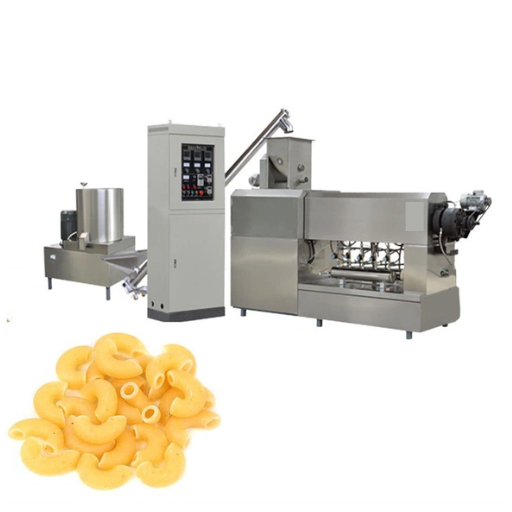
Creating Porous Structure for Rapid Rehydration
This quality is highly dependent on the rehydration speed. Consumers usually expect noodles to become edible in 2 to 3 minutes post-immersion in hot water. This can only be achieved with an extremely porous internal structure unfolding rapidly with water uptake.
Microwave-assisted vacuum drying was a result of the achieved structure through controlled steam expansion. So set at about 50°C, the moisture inside enters with noodles and the microwave energy is absorbed, making internal moisture exceedingly hot. Due to the vacuum’s low external pressure, the generated steam inside the starch matrix will expand instead of collapsing. Once the vacuum is released, the porous form maintains back in a stable state.
Instant noodles obtained in this manner rehydrate in 90 seconds to 2 minutes. They create a finished product that, in texture, is closer to the fresh-cooked pasta thing than the edgy, hot-air dried product.
Controlling Expansion and Texture
The level of expansion has a significant influence on the texture of the product. A high expansion produces a lighter but more porous noodle. Conversely, less expansion gives a product that is denser and chewier. With such varieties in textures, consumers from different parts of the world express their preferences similarly too. The tastes could be described as Southeast Asian people who favor a light and a highly porous noodle, whereas in European markets, dry, quick-cooking, and slightly denser pasta may be sold.
Independent Variables
1. The vacuum level or pressure: Lower pressure positively influences expansion. Normal Range: 20 to 60 hpa are common.
2. Microwave power density or power supplied into the chamber: The higher the power density, the higher the rate of foam generation and expansion.
3. Initial moisture content: More moisture begets more expansion, though this requires a longer drying time.
4. Starch properties: Amylopectin increases foam strength during the intense and mordant period of expansion.
Quality Metrics for Instant Noodles
Microwave-vacuum-dried instant noodles should be subjected to the following evaluations by manufacturers:
- Rehydration Rate: To be approximately under 2 minutes for regular instant noodles and under 90 seconds for premium products.
- Cooking Loss: Starch leaching during rehydration should remain below 8% to 10%.
- Sensory Score: Professional panels evaluate springiness, chewiness, surface smoothness, and overall acceptability. Laboratory-controlled tests show microwave-vacuum-dried noodles’ sensory score remains equal or superior to hot-air-dried noodles.
When Liu Wei, quality manager at a Jiangsu instant noodle export company, faced a major retailer in Europe insisting that his hot-air-dried noodles could not be accepted (here, the issue was a rehydrating time of 5 minutes as opposed to the preferred under 3 minutes), Liu got creative. He put in a 100 kW microwave vacuum system, which got the noodles hydrated in 1 minute 45 seconds. The porous structure of the noodles also helped sauce absorption, which had the flavor sheet of the retailer rate Liu’s noodles higher than the existing supply that the retailer was having. That facility of Liu ships 8 million product servings per month to a single major account.
Industrial Pasta Drying Applications by Segment
Dry Pasta Manufacturing
Microwave dry pasta waste-to-energy plantation is one of the main sectors of food production. The storage life of 12% moisture content durum wheat pasta improves beyond 2 years without any deterioration in quality. With reliable proof, the application is taken care of using microwave hybrid systems.
Major application-specific requirements include: uniform texture, minimum breakage, and a consistent final moisture content. Another advantage of microwave drying is pasteurization, which leads to lowered bacteria load at packaging that would lead to better shelf life and a lessening of complaints from customers.
Instant Noodle and Quick-Cook Pasta Facilities
This sector involves the technical know-how of working on microwave-vacuum systems. Volumes are massive: global instant noodle consumption exceeds 120 billion portions per annum. Manufacturers aim for rehydration speed, texture, and price competitiveness.
The advantages in microwave-vacuum drying based premium positioning are also highly sought after. Better rehydration and taste lead to higher margins in the increasingly competitive world markets.
Fresh-to-Dry Specialty Producers
A goodly number of small-scale, farmhouse pasta producers and the large-scale artisan types-and even individual specialty lines which include limited runs-are now employing small batch microwave dryers for drying. A 24 kW batch unit can give 3 to 4 cycles per hour during recipe development. Compare that with the usual batch drying scenario, which permits 1 cycle per day on some typical configurations.
A small producer can now perhaps test a new shape or formulation with different ingredients within the same day. This ability becomes the strength for launching newer processing stages of product development. So what usually takes 6 months with conventional drying can now be accomplished in 6 weeks with a microwave batch system in the case of new-product development or testing of existing recipes.
Gluten-Free and Specialty Pasta
Bean pasta, lentil pasta, pea protein pasta, and other alternative formulations of these dry differently than durum wheat products because their starch structures and protein content are different and may not be dispersed similarly during moisture migration.
Because microwave drying is able to provide more temperature control and be an appropriate choice for the same, it prevents the breakdown of proteins and starches due to poor drying, which guarantees the production of gluten-free pasta with a good taste.
Ready-to-Cook and Pre-Packaged Meals
No need for colloquialized language to emphasize the productivity of every railroad. due to a lack of refrigeration. The simultaneous drying and pasteurization by microwave allows for a step to be pulled out, cutting down greatly on the complexity of production, apart from saving costs.
Products destined for foodservice or retail ready-meal sections benefit particularly from this dual-function food processing microwave drying approach.
Microwave Pasta Dryer Pricing and ROI
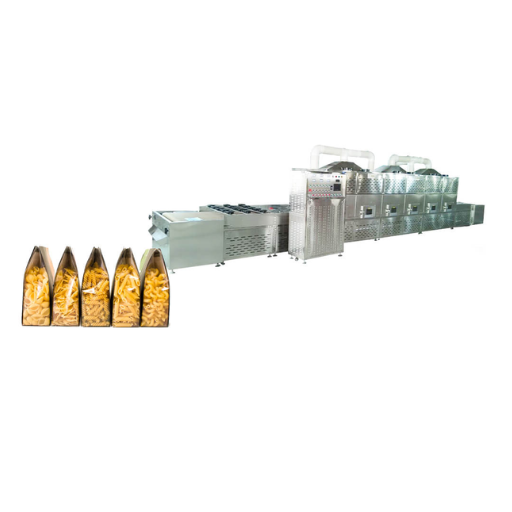
Price Ranges by Power Tier
Industrial pasta drying machines span a broad price range relying on capacity, setup, and customization:
-Small batch systems (12 to 30 kW): 8,000-fff; 25,eee. These are suitable applications for R&D, pilot production, and specialty producers.
-Medium-sized continuous tunnels (50 to 100 kW): This will range in the vicinity of 35,ggg to 80,ttt. These are the standard configurations for commercial pasta factories that may produce between 1,000 and 3,000 kg daily.
-Enormous industrial lines (150 to 300+ kW): This large option is priced around 100,tttt to 250,zzzz. These numbers require big installations, integrated with extrusion lines handling 5,000+ kg a day.
All the above are for equipment expenses only. Installation, electrical works, and integration with existing line are an additional cost, of 15 to 25% over and above the specified numbers.
Factors That Affect Cost
Several factors contribute to the final cost:
- Belt width and conveyer length: The broader belts and longer tunnels use more material and are more expensive to manufacture.
- Hybrid integration: Including hot air predrying segments initially adds to the cost, but it decreases running costs and increases productivity.
- Vacuum capability: When purchasing vacuum systems in opposition to atmospheric systems, consumers have to be ready to dish out an extra 20,000 to 550,000.
- Automation level: Another issue is just how advanced the system is, off-the-shelf PLC control is more than basic control with recipe storage, remote diagnostics, and an automatic moisture linear feedback.
- Material specifications: Changing to SUS316 construction or obtaining special materials for the belt or building extra shielding will add to the set cost.
Calculating ROI
Payback for an industrial pasta dryer system falls generally between 18 and 36 months. The prime motivator toward the upgrade to microwave dry pasta includes:
- Increase in Production: A 300 to 400 percent increase in the facility’s volume represents a quick return of profits that equals equipment cost when a plant’s daily capacity goes beyond 3,000 kg out of the 800 kgs before.
- Utility Savings: Savings in utility, whose baseline goes low as 26% while it starts to save a month. A case where the facility will have been saving $8,000 monthly in bills for drying energy, post-microwave hybrids, eventually adding up to about $100,000 annually.
- Space Efficiency: With an area of 4,000 to 5,000 sqm regained, due to no new cake dryers, a great saving in construction expenses are realized or this very space will be operational for income generating equipment. Rent saved is about $200,000 to $250,000 annually at an average rate of $50 per square meter per annum on the rent.
- Less overseeing means that workers get more non-productive work done. Besides, shorter drying cycles reduce WIP, and the same is advisable for elimination of time loss in any handling.
- A Rare “Pasteurization Dividend.” Superb commingling of time, capital, and resources allows disruptively less-used items to regenerate their aligned purposefulness. Blanket approval is given to end, disassemble or temporarily shut down an old dedicated line that went orphaned into pasteurization.
Want a detailed ROI calculation for your facility? Request a custom pasta drying quote with throughput analysis and payback projections.
How Shandong Loyal Industrial Engineers Pasta Drying Solutions
Application-Driven Design
We don’t sell off-the-shelf processing catalogs. We customize each system according to detailed pasta types, targeting production capacities, and specific constraints within the production facility. Our process starts with materials-based testing purposes: we dry samples of your actual product in one of our pilot facilities in order to ascertain the optimal power density, temperature profile, and residence time.
This valuable information enables us to primarily devise unique equipment requirements tailored to your product. For instance, a penne producer and an instant noodle manufacturer would have different magnetron placements, belt speed ranges, and geometrical dimensions of the chamber. Both would get a system designed to perfection for their product.
Hybrid System Integration
Our engineers design hybrid systems that integrate easily with existing extrusion and cutting lines. We make sure belt heights support seamless operation by tying together transfer points and control interfaces with the drying system.
For a greenfield site, we would design and integrate an extruder, cutter, dryer, and packaging line as a package. The great thing about single-source responsibility is that the supplier doesn’t have to worry about conflicts between interfaces of separate suppliers.
Recipe Development Support
The start of operations at multiproduct sites can provide for new recipe development. Technicians will work together with the plant’s operators, entering the necessary setpoints into the PLC for each type of pasta they make. Temperatures, speeds of the belts, power demands, and water contents are all recorded.
Your operators will be familiar with the use of the product database and be able to work on writing and modifying the production technology obtained with PLC, during the training. The PLC can have until 200 product settings stored, supporting the most extensive fully programmed files on the market.
Global Installation and Support
Our teams on installations have commissioned microwave drying systems across Asia, Europe, North and South America, and Africa. We bring a lot to bear on a commission weekend:
- On-site installation and alignment with existing equipment.
- Operator-training on PLC control, recipe selection, and regular maintenance.
- Commissioning validations with your actual product to confirm performance-guarantee achievement.
- Priority technical support via phone, video, and on-site dispatch when needed.
All systems carry a standard manufacturing warranty with extended support options.
Frequently Asked Questions About Microwave Dry Pasta
What Is Microwave Dry Pasta Technology?
Microwave-assisted dry pasta technology is the use of industrial microwave energy to extract moisture from fresh pasta with high and uniform precision. Microwave drying operates on the principle of the heat being generated volumetrically all over the pasta and is thus set apart from drying with hot air technology that heats the product from the outer side inward. Thus, the unit poses effective drying cycles requiring only 8 to 12 hours down to below 90 minutes for drying purposes, with no long-term property attrition such as texture, color, and rehydration. This process also accomplishes simultaneous pathogen pasteurization, causing over a 90% reduction in the microbial count.
How Much Time Will the Microwave Oven Dry Pasta?
A full dryer cycle including hot-air pre-drying, microwave, and equalization times will be right around 1 to 1.5 hours. In actual terms, the microwave drying time constitutes 8 to 13 minutes of active microwave running using the time-temperature control option, based on the specific pasta type and size. Meanwhile, the old, conventional hot tunnels are used for about 6 to 12-hours to evaporate the leftover moisture. These are the vacuum technology-based Instant Noodle microwave dryers, which would conclude the drying stage in as little as 500 seconds.
Did Microwave Drying Prove Good for Pasta?
For all commercial pasta companies, hybrid microwave drying outperforms straight- hot air drying in terms of speed, power efficiency, space necessary, and food safety criteria. Microwaves deliver drying at ten times the pace, using 26% less power, and conserving 90% on space while pasteurizing in the process. The best compromise now-the most cost-effective scenario-employs hot-air pre-drying followed by finishing with microwaves as the right combination, highlighting microwave alone as not the best option after all. Over that, heating with hot air will quickly eliminate surface moisture prior to microwaves entering in to access internal moisture.
What Is the ROI of an Industrial Pasta Dryer?
Return on the industrial pasta dryer is typically within the recuperable range of 18 to 36 months approximately. In this case, the extra 3,500 kg per day for that output equipment is fully generating recoverable gains. The energy-cost savings amount to 26% compounded monthly. The floor space saving will be about 90%, which saves establishment expenses for an additional equipment installation or allows more revenue-generating machines to be set up. The advantage of pasteurization totally cancels out or partly reduces costs operating separate sterilization equipment.
Can All the varieties of pastas be microwave-dried?
Microwave drying of pasta is effective for the removal of the existing moisture in most pasta types, including short-cut shapes, long-cut strands, instant noodles, egg pasta, and gluten-free formulations. These require different temperature profiles and dwell times. Short-cut pasta processes at 80-90°C, whereas long-cut pasta will have to be profiled differently—no more than 70-80°C to prevent brittleness. Egg pasta doesn’t get hot; the temperature shall not exceed 10-15°C than the final water temperature at 60-70°C. Stuffed types like ravioli require power profiles that could be easily adjusted when juxtaposed against different microwave designs.
What Is the Best Power Rating for Pasta Production Line?
1.3. Do not claim microwave production offers increased. 12-30 kW batch systems allow one to perform R&D and specialty production at between 100-500 kg/hr because a 50-100 kW continuous tunnel is designed for 800-2000 kg/hr for most commercial manufacturers. Large industrial lines at 150 to 300+ kW process 2500 to 5000+ kg/hr and are integrated with high-speed extrusion systems. Specifications will be needed to take note of target volume, pasta density, and initial moisture content to consider the microwave output selection.
Conclusion
The microwave dry pasta technology dramatically boosts profitability for pasta and noodlemakers. This is evident from the fact that the drying process can be completed in minutes rather than hours, resulting in energy savings of up to 26%, lowering floor space needs by up to 90%, and serving for pasteurization flexing to eliminate separate sterilization process.
Main points to note for good performance:
- Hybrid arrangements outdo simple microwave drying or hot-air drying alone systems. A three-stage system, hot-air pre-drying to microwave drying to equalizing, tops for microwave dry pasta.ountries for collectively delivering better product quality, efficient production of microwave dried pasta.
- Know your pasta product when choosing your equipment. Short-cut pasta, long-cut pasta, instant noodles, and egg pasta may be dried at utterly different drying conditions with temperature profiles, power density, and dwell times.
- Producers requesting silos gain exceptional interest from microwave-vacuum drying. The porous structure offers a rehydration time less than 2 minutes, ideal for a premium market standard.
- ROI might be reached from an 18-36-month period more cost effectively through enhanced capacities, conserved energy, less floor area, and sterilization cost savings.
- Power density will carry more weight than wattage. This author has been personal to initiate a lasting impression-power with a hit-controlled microwave, plus the temperate monitoring system, makes far better pasta than kW ratings alone does.
Not all microwave systems would handle pasta the same way. Success will depend on matching all system specifications for the pasta types in your production mix, your production volume, and the output quality requirements. If your interest is getting assistance on pasta processing along with Microwave Hardware, your equipment supplier is determining the fate of your investment.
Ready to engineer your pasta drying upgrade? Contact Shandong Loyal Industrial today to schedule a custom drying assessment, pilot test your products in our facility, and receive a detailed equipment proposal with ROI projections tailored to your production line.